
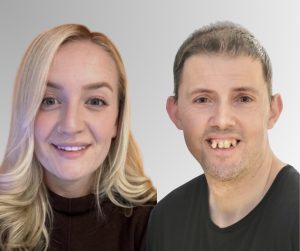
 Peter Pamphlett and Eve Emsley co-deliver Breaking Down Barriers, a practical workshop that shares lived experience and inclusive practice for dance and creative professionals.
DanceSyndrome’s Breaking Down Barriers is a one-day online workshop for dance and creative industry professionals who want more practical tools to help to make dance and creative spaces more inclusive for people with learning disabilities. The course blends discussion, practical activities and reflection and includes a certificate, downloadable resources and post session materials.
The training is co-delivered by Peter Pamphlett, a Dance Leader who brings lived experience of a learning disability, and Eve Emsley, DanceSyndrome’s Leadership and Inclusion Facilitator. The workshop is designed in line with DanceSyndrome’s co-production model which means that people with lived experience of learning disabilities inform all content creation and delivery to give an authentic learning experience.
 Peter brings real life perspectives and 16 years of practical delivery experience with DanceSyndrome. He demonstrates how simple communication techniques and confidence building can make a profound difference to feeling included. Peter co-creates and co-delivers sessions to ensure participants hear directly from someone with lived experience, helping to shift assumptions and change working practice.
Peter said: “I like delivering inclusion training because I want to inspire more people to see how we can work, change their perceptions and help them to think outside the box about how to do things in the way DanceSyndrome does. As a person with lived experience of having a learning disability, I know that when barriers are broken down for me, it means I’m more included in society. I can share this learning with people who join our workshops. We show people how to see new ways of doing things and how to fix problems in ways they might not have thought of before.”
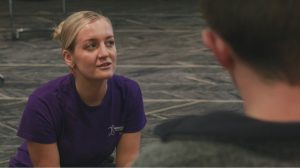 Eve has vast and varied experience of delivering workshops around inclusive practice, leading on co-produced projects, teacher education, community initiatives and managing diverse staff teams. Her facilitation supports people to reflect on everyday barriers people may experience and think through how to put accessible changes in place.
Eve said: “Inclusion, representation, and co-produced services matter. We facilitate spaces for professionals to reflect internally, evaluating their own practice and externally, considering the environments they work and live in. Our workshops offer an insight into what a fairer and more inclusive society could look like, offering space to hear a variety of perspectives.
“We encourage practitioners to start small with implementing changes within their control as we believe small shifts in attitude, behaviour, process, and language can make a big impact in creating environments where people are included.
“Our aim is for our sessions to provoke thought and generate new approaches, informed by lived experience. We encourage participants to arrive as they are, there will be enough space within our delivery for practitioners to feed in questions and discussion points that relate to their practice.”
Why inclusion matters
At DanceSyndrome we know barriers can be physical, informational and attitudinal. Our workshops aim to shine a light on these issues and to plant seeds for long term change. Participants from previous inclusion workshops tell us that they leave ready to take new ideas back to their teams, to role model inclusion and to start changing how their organisations work.
To find out more about Breaking Down Barriers, you can download an information pack on this link. To book a place on the next course on Monday 10th November, please complete the booking form below:

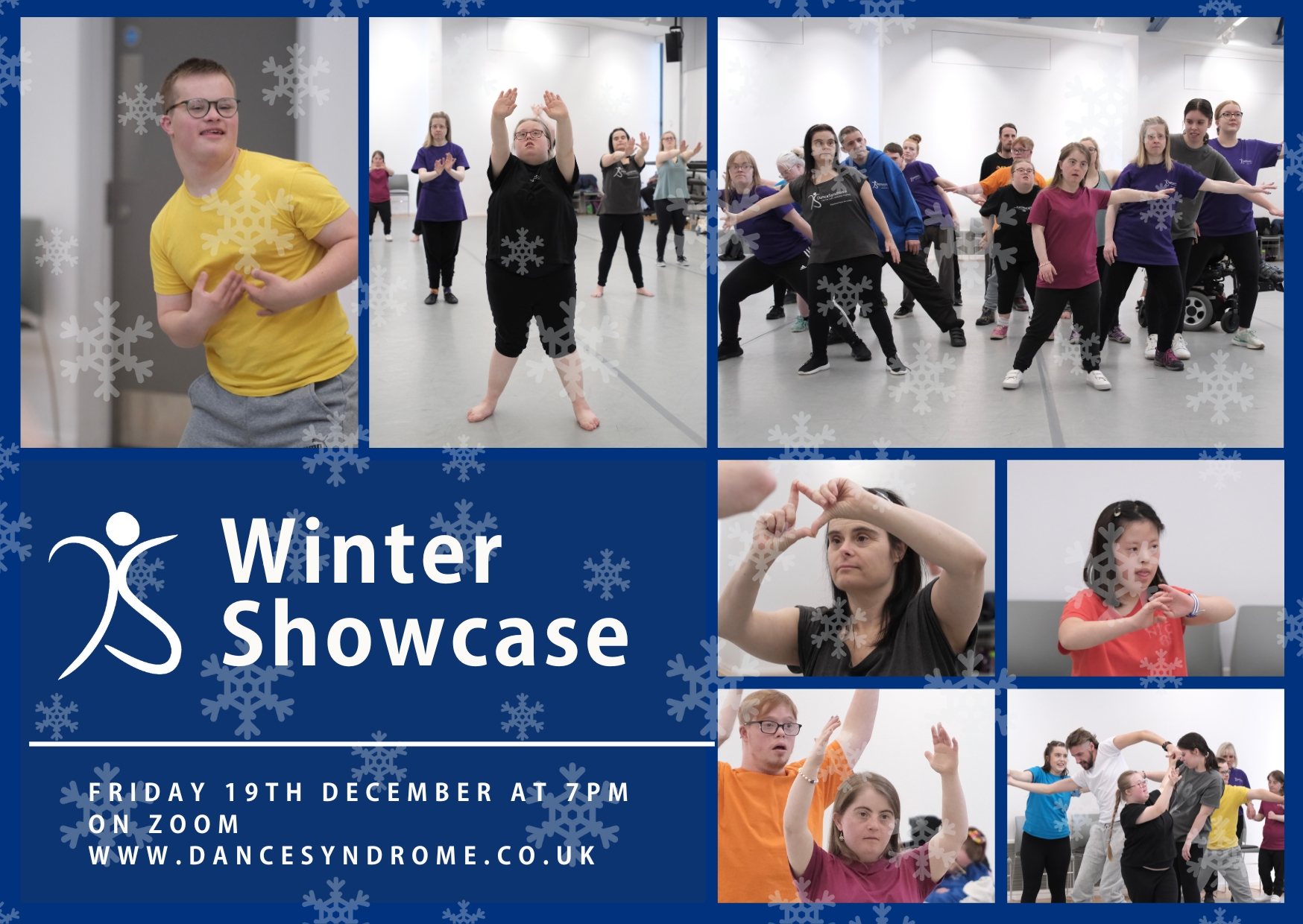
Join the DanceSyndrome team for our online Winter Showcase, demonstrating the hard work of the participants in our online dance sessions. Please use the form below to book your tickets and make your Pay as You Feel donation.

 DanceSyndrome co-founder Sue Blackwell won the Lifetime Achievement Award at the Best Business Women Awards 2025, which took place on Friday 10th October in Daventry.
Sue and her daughter, Jen Blackwell, formed DanceSyndrome in 2009 after Jen, who has Down’s syndrome, found it difficult to find training and opportunities that would support her to become a community Dance Leader.
The Best Business Women Awards were created eleven years ago to celebrate the achievements of female-led businesses and charities. The awards recognise leadership, innovation and dedication across many industries. Winners were chosen by an independent panel from hundreds of entries.
In their feedback about Sue’s nomination, The Best Business Women Award judges said “This lady is an inspiration to us all. Her determination knows no bounds and the growth of this incredible business and charity is wonderful. Sue’s commitment to encouraging those who are often sidelined by their disabilities is very impressive. Her commitment to those she supports has been steadfast and unwavering.”
Speaking about the award win, Sue said “I’ve only ever wanted individuals to be seen and respected as humans, giving everyone the right support to be able to live a fulfilling and purposeful life of their choosing. I’m honoured to receive this award and feel the recognition and vindication of everything I’ve always stood for – equity, respect, inclusion, love.”
Sue was proud to attend the awards with both her daughter Jen and her son Anthony. Jen said “I’m so proud of my Mum. Together we created DanceSyndrome which has given me my life.”
Speaking about Sue’s award, Debbie Gilbert, founder and organiser of the Best Business Women Awards, said “You built the door that no one else had the courage and determination to do and you created so many opportunities not just for your own daughter but for thousands of other people and you are so very well deserving of a lifetime achievement award for creating such a wonderful charity that has had such a lasting impact on so many people.”
If you’re inspired by Sue and Jen’s story, you can join an inclusive dance session, volunteer with us or support us in a variety of different ways. We’d love to have you involved!

What Does Inclusion Look Like? The Small Things That Make a Big Difference
Throughout National Inclusion Week, DanceSyndrome, along with many other organisations, shares stories about the importance of inclusion and why society needs to become more inclusive. But what does that really mean in practice?
When people hear the word “inclusion”, it can feel like something complicated, expensive, or reserved for specialist consultants. But at DanceSyndrome, we’ve learned that inclusion isn’t about ticking boxes or making grand statements. It’s about the small, everyday choices we make to ensure that everyone feels welcome, supported and able to be their own unique self.
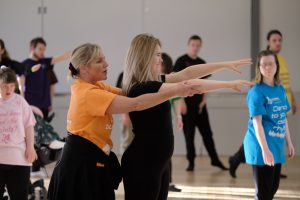
In our dance sessions, we constantly make little adjustments to help our dancers to feel safe and confident. It might be as simple as:
• Slowing down instructions so people have time to process them.
• Using gestures alongside words to make communication clearer.
• Offering options instead of expectations, so individuals can choose how they take part, making it meaningful to them.
• Building in pauses and reassurance, so no one feels rushed or judged.
• Remembering that everyone’s way of moving is valid and beautiful.
But these are just the visible things that happen in the dance space. DanceSyndrome’s approach to being completely inclusive and accessible goes far beyond this. If you are a regular follower of our social media, you may have heard us use the phrase “…what can be achieved when people are supported properly.” This goes far beyond adaptations to dance and movement.
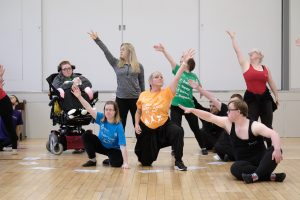
On a daily basis, our team works to support our Dance Leaders, and their families, in whatever ways they need us to. This includes supporting people to remove a wide range of barriers that might otherwise prevent them from pursuing the opportunities that we offer. This might include seemingly small things like booking taxis, shopping for clothing, ordering sunflower lanyards/access cards, changing the method we use to communicate with them or providing easy read communications to much bigger issues like helping them to access other volunteering or employment opportunities, or navigating social services and healthcare system. We employ a trained counsellor to attend out Weekly Company Class each week, to provide additional mental health support to our Dance Leaders. We appreciate that people may need a carer or support worker with them to provide physical or emotional support to come to our events, so we aim to support with financial barriers related to this, because we understand that everyday living is expensive when you always need to take a second person everywhere you go.
We invest our time and money into helping people to overcome these challenges because it is fundamental to being inclusive. These small adaptations are powerful. They tell people:
“You matter here.”
“Your way of expressing yourself is just as important as anyone else’s.”
“We want you to be a part of this.”
Being treated this way is important to EVERYONE, but especially to people with learning disabilities who might have been excluded from many aspects of society throughout their lives.
These everyday actions prove that inclusion in dance isn’t any different from inclusion in the workplace, the classroom or the community. Whether you’re a teacher, a manager, or a team leader, the same principles apply in your space. When you communicate clearly, allow time, create safety, and value individuals, they will thrive.
This is a core part of the way that DanceSyndrome has always operated. We are learning new ways to be more inclusive every day, and we always aim to share learning and work in partnership when we can.
If you work for an organisation that is looking for help to become more inclusive, we can share our approach through our successful Inclusion in Action workshops. These sessions are for any organisation that wants to build more inclusive workplaces. The workshops are co-delivered by people with learning disabilities, offering insights based on lived experience and practical ideas that can be put into practice quickly and easily, but make a significant difference. You will leave not only with a new understanding of inclusion, but also with a pledge to make your own simple changes to make your environment more welcoming.
For those working in the dance sector, Breaking Down Barriers is our course specifically for dance professionals who want to make their practice more accessible. It explores the challenges dancers with learning disabilities may face and gives you practical tools, action plans and resources to create spaces where every dancer can thrive.
We are delivering an online version of Breaking Down Barriers on Monday 10th November 2025. If you would like to book a place on this course, please visit this booking page.
For more information about both Inclusion in Action and Breaking Down Barriers, please visit our Inclusion Training page.

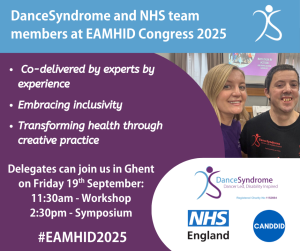
The DanceSyndrome team is excited to be delivering two activities at the EAMHID Congress in Ghent, which takes place from Thursday 18th to Saturday 20th September 2025.
EAMHID is the European Association for Mental Health in Intellectual Disability. Every two years, they deliver a congress where people from over 25 countries come together to share ideas and learn from each other’s experiences.
EAMHID Congress 2025
International Congress Center (ICC), Ghent, Belgium
Thursday 18th to Saturday 20th September 2025
DanceSyndrome will be delivering two activities on Friday 19th September:
- 11:30am – 1:00pm: Embracing Inclusivity Workshop
- 2:30pm – 4:00pm: Solicited Symposium: “How healthcare and mental health can be transformed by inclusive and creative arts and practices”
How to sign up:
Our workshop at 11:30am is part of the “Parallel Sessions 4” programme and the location is H VAN EYCK.
The Solicited Symposium at 2:30pm is part of the “Parallel Sessions 5” programme and the location is Auditorium.
If you are at the EAMHID 2025 Congress, we would love it if you would choose to join us for these sessions. More information about the content of the sessions is below.
You can book your place at the Registration Desk on the day.
About Our Work
DanceSyndrome uses co-produced, inclusive dance as a vehicle to transform lives.
Dance helps to make people feel better both physically and mentally. It enables the opportunity to meet new people and gain confidence, giving people the skills needed to become leaders and professional performers. Our work supports people with and without Intellectual Disabilities. We believe everyone should be able to enjoy dance and feel they belong.
At EAMHID we will:
- Hear from experts by experience with Intellectual Disabilities who lead and perform with DanceSyndrome.
- Present academic research in partnership with NHS team members working in the fields of Mental Health and Intellectual Disability.
- Share real-life stories and data about how dance can help with mental health and wellbeing.
- Show how our workshops help other organisations to work more inclusively.
- Give practical ideas for overcoming barriers in a range of settings.
Embracing Inclusivity Workshop (Friday 19th September, 11:30am – 1:00pm)
Our workshop at 11:30am is part of the “Parallel Sessions 4” programme and the location is H VAN EYCK.
The workshop will be delivered by:
- Eve Emsley (DanceSyndrome Leadership and Inclusion Facilitator)
- Peter Pamphlett (DanceSyndrome Dance Leader and Trustee, expert by experience with an Intellectual Disability)
This is a practical, friendly workshop based on our Inclusion in Action training which is co-delivered by a person with an Intellectual Disability.
Delegates will:
- Learn about the everyday barriers people with Intellectual Disabilities face (for example: attitudes, physical access issues and information that is hard to understand).
- See how DanceSyndrome creates a safe space. We’ll show you simple ways to use words, movement, time and use reflective practice to consider small changes to make your own space more inclusive.
- Take part in an experiential workshop which incorporates accessible movement that can be adapted for all abilities
This session is ideal for anyone who wants to make their own setting more inclusive. It is a practical workshop that involves adaptable movement but does not require delegates to have any experience of dance.
Solicited Symposium: “How healthcare and mental health can be transformed by inclusive and creative arts and practices” (Friday 19th September, 2:30pm – 4:00pm)
 The Solicited Symposium at 2:30pm is part of the “Parallel Sessions 5” programme and the location is Auditorium.
This is a joint presentation between DanceSyndrome and the NHS which will discuss the challenges of mental health care for people with intellectual disabilities and show how creative approaches can help.
The presenters are:
- Louise Howitt & Hannah Randall (NHS, supervised by CANDDID)
- Eve Emsley (DanceSyndrome Leadership and Inclusion Facilitator) and Peter Pamphlett (DanceSyndrome Dance Leader and Trustee, expert by experience with an Intellectual Disability)
- Julie Nicholson (DanceSyndrome Managing Director)
Delegates will learn about:
- The latest research into the impact of creative activities on health and wellbeing.
- How conventional therapies like CBT may be hard for some people to access and why creative approaches can be a helpful alternative.
- How DanceSyndrome and the NHS work in partnership to put inclusion into action.
- Give real examples and stories from people with lived experience of Intellectual Disabilities.
- Watch a short performance by Ellie (a Dance Leader with an Intellectual Disability), with a voiceover from her mum Cath, talking about what DanceSyndrome means to them.
This session is ideal for anyone who is interested in creative approaches to health and wellbeing or those who are advocates for greater inclusion in society. The activity does not require delegates to dance.
If you are attending EAMHID Congress 2025, we would love to meet you in Ghent and share ideas about how dance and creativity can change mental health care for people with Intellectual Disabilities. You can book your place at the Registration Desk on the day.
If you would like to know more about EAMHID Congress, you can find all the details on their website or on the EAHMID app.
If you would like to sign up to receive more information about DanceSyndrome and our activities at EAMHID Congress 2025, please complete the brief form below.

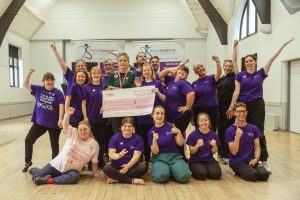 DanceSyndrome is celebrating after being awarded £340,528 in National Lottery funding to support our work with people with learning disabilities.
Beth Cox from National Lottery Community Fund attended our Weekly Company Class in Preston on Wednesday 10th September to present the DS Collective with a giant cheque for the funding, which will support a new project called “Pathways to Thrive”.
The new project, which covers the next five years, is about creating pathways for children with learning disabilities to take part in accessible dance sessions at all ages, leading up to joining DanceSyndrome’s existing sessions for adults.
DanceSyndrome currently co-delivers four public in-person Everybody Dance community sessions and five online sessions every week, alongside a wide range of performance and professional development opportunities. Adults with learning disabilities attending these Community Dance sessions reported that DanceSyndrome has helped them increase their confidence, learn new skills for independent living, volunteering and work, and develop a sense of belonging. Over the last two years, work has begun to expand this impact by working with young people, as well as adults. A DS Youth Collective was formed in 2023, and the success of this group highlighted the need for a wider programme of inclusive activities for children and young people in the North West, and beyond.
The new funding from The National Lottery Community Fund, will see new sessions being created for children at different stages of development, including Early Years, Infants, Juniors and Teens. This will create a full pathway in each location where DanceSyndrome delivers sessions for adults.
Julie Nicholson, DanceSyndrome Managing Director said: “We’re delighted that The National Lottery Community Fund has recognised our work in this way. Now, thanks to National Lottery players we will be able to create accessible opportunities for people of all ages and abilities to enjoy the amazing health and wellbeing benefits of dance and movement. This is so important because we regularly hear from families whose children absolutely love to dance and feel huge benefits from it, but find it difficult to access mainstream activities. Everyone in society benefits when people of all abilities are supported and included. We want to put that into practice from a very young age, so that families can feel connected with their communities and access the life-changing opportunities that dance can bring.”
The National Lottery Community Fund recently launched its strategy, ‘It starts with community’, which will underpin its efforts to distribute at least £4 billion of National Lottery funding by 2030. Everyone at DanceSyndrome is thrilled to have this significant support for our work over the next five years!
If you would like to register your interest in our future workshops for children and young people, please complete the form below.

 Breaking Down Barriers is a one-day, online workshop for dance and creative industry professionals who want practical tools to make their classes, auditions and creative spaces more inclusive for people with learning disabilities.
Co-delivered by Peter Pamphlett, a Dance Leader with lived experience, and Eve Emsley, our Leadership & Inclusion Facilitator, the workshop blends discussion, practical activities and reflection. The fee includes a certificate of attendance, downloadable resources and access to post-session materials.
For more information, please download the Breaking Down Barriers Information Pack.
If you are a professional who is looking to make your dance/creative practice more inclusive, then book your place on our Breaking Down Barriers workshop by completing the form below!


Dancing for Change: What We Learned During DanceSyndrome’s Environment Week
At DanceSyndrome, we believe that dance can do more than just entertain, it can change perceptions, inspire action and bring people together. That’s exactly what happened during our first-ever Environment Week, which took place from Monday 28th July to Friday 1st August 2025.
This special week was created to spark conversations around climate action and environmental sustainability. We wanted to use movement, creativity and community to encourage people of all abilities to think about their own environmental impact.
Environment Week was co-produced by our passionate Environment Champions [pictured left to right] Kate Battersby (Professional Development Manager), Lucy Burgess (Dance Leader) and Sarah Calderbank (Communications Manager), who spent months designing activities that were accessible, educational, and fun.
The team worked together to create a downloadable, paper-less brochure about Environment Week, which you can download on this link. This brochure shares learning from the last year and some ideas about how everyone can get involved in Environment Week themselves, including dates for beach clean events, ideas for meat-free meals and ways to help plants and animals to thrive.
Throughout the week, the DanceSyndrome team turned our weekly inclusive dance sessions into opportunities for environmental learning. Both the community and online Everybody Dance sessions all had inspiring themes, including plants, animals, different environments and outdoor spaces and the weather. One group used branches from a fallen tree outside the community centre as props. Our Chorley group imagined that they were dancing through Astley Park, imagining the woods, the open space and thinking about the things they might see and hear to inspire them.
Our DS Collective and DS Youth Collective members were invited to join us for two special days of activities which were focused on learning about the environment.
View this post on Instagram
Monday: Litter Picking and Learning in the Park
On Monday 28th July, members of the DanceSyndrome performance collectives gathered in Miller and Avenham Park in Preston for a morning of litter picking, followed by a plastic and meat-free picnic and a dance session inspired by the nature found in the park.
Preston City Council’s Head Gardener, Mick Ashmore shared some powerful insights about how climate change is already affecting local green spaces:
- The Aucuba Laurel, a vital winter-fruiting plant that supports birds and other wildlife, is dying out due to climate change. Gardeners are now planting alternative species to maintain food sources for resident species.
- The park has stopped using pesticides in green spaces, to protect pollinators like bees, butterflies, and other insects. This change also supports animals higher up the food chain, such as hedgehogs, which are declining due to insect loss.
- 98% of park waste is recycled, with the remaining 2% going to incineration to become renewable energy.
- Mick also explained that without ongoing gardening, the park’s ecosystem would suffer, with plants crowding each other out, and safety risks would increase. The beauty and biodiversity we enjoy relies on careful, ongoing work from their dedicated team.
Mick’s “behind-the-scenes” perspective gave us all a new appreciation for the people and practices that keep green spaces healthy. It reminded us we can all play a part in looking after the environment.
Inspired by what we learned, we created site-specific dance movements in the park, reflecting the textures, shapes and energy of the natural world around us.
Wednesday: Words, Movement and Environmental Messages
On Wednesday 30th July, our DS Collective dancers had the chance to explore the intersection of activism and art through poetry, music and film.
In the morning, we worked with Claire Beerjeraz — a writer, performer, spoken word artist, and creative therapist who blends creativity with activism to bring attention to urgent social and environmental issues.
Claire invited dancers to think about words they associate with nature, then supported them in turning those words into original poetry. The group then layered dance and movement over the poetry, resulting in a powerful, multi-sensory exploration of what the natural world means to each of us.
This was the first time DanceSyndrome had blended poetry and dance in this way and it brought about some incredibly moving and reflective moments.
In the afternoon, we welcomed filmmaker Sima Gonsai, who shared her 2022 short film ‘Cultivate,’ a duet performed by two dancers which draws on research into soil health, farming practices and ecological preservation. Through a unique fusion of South Asian dance and film, it highlights how the soil beneath our feet is alive and sustains all life, including us.
After the screening, Dance Leaders had the opportunity to interview the filmmaker, ask questions about the creative process and reflect on how dance can be used to raise awareness of climate issues.
This session challenged us to think beyond our own experiences of dance performance and consider how art can be a tool for environmental change.
View this post on Instagram
What We’ve Learned
Throughout the week, DanceSyndrome’s community showed how small actions can make a big difference. Whether through litter picking, changing our eating habits, recycling or expressing ourselves through art, we all found new ways to think and talk about climate action.
Our Dance Leaders, many of whom have learning disabilities, led the way with energy, creativity, and insight, showing that inclusion and sustainability can go hand in hand in exciting ways.
As part of our work as an Arts Council England National Portfolio Organisation, we’re committed to embedding environmental responsibility into everything we do, not just for Environment Week, but all year round.
What Made DanceSyndrome’s Environment Week Work?
Everyone can make small changes that help the environment. We have embraced all actions no matter how small, because they all add up to change!
We don’t want the environment and climate change to be something that causes worry for our dancers. We think it can be fun to think about the environment and to try new things that make the world a better place! Our new, challenging activities were fun and interesting and made people want more!
We asked people to only do what they are able to do and feel comfortable with, just like when we dance. This enables people to get involved and empowers them to make change in their own way.
Remember, even the smallest changes all add up to make a difference, so don’t be afraid to give something a try! Why not download our Environment Week guide booklet to get some inspiration?
Want to learn more or get involved?
Follow us on social media: Facebook, Instagram, BlueSky, Linked In and YouTube
View this post on Instagram

 DanceSyndrome Launches First Ever Environment Week!
Monday 28th July – Friday 1st August 2025
DanceSyndrome is inviting everyone to join our first ever Environment Week, a celebration of sustainability, community and creativity through dance. All of our inclusive dance sessions during the week will include an environmental theme, which will be co-produced using topics chosen by our individual Dance Artists and Dance Leaders with learning disabilities.
As an Arts Council England National Portfolio Organisation, Environment Week is part of our wider commitment to Environmental Responsibility, recognising that just as people thrive with the right support and care, so does our planet.
Follow us on social media this week as we’ll be spotlighting the work of our Environment Champions, sharing fun and accessible independent activity ideas, and encouraging people to take small but powerful actions, like reducing plastic use, joining a beach clean-up or cooking a meat-free meal.
 Lucy Burgess is the Dance Leader Environment Champion. Lucy said “I’m proud to be Dance Leader Environment Champion. I am passionate about the planet. I want to tell other people why it’s important too.”
DanceSyndrome Environment Lead, Sarah Calderbank, said “This week is about small steps with big impact. We want to inspire our dance community, including people with learning disabilities, to feel empowered, not overwhelmed, by the idea of helping the planet. We hope everyone can learn something new and have fun in the process!”
DanceSyndrome has created a booklet which shares our learning about the environment and some inspiration about how you can get involved! Download the Environment Week Guide here:
We’d love to see what our dancers are doing during Environment Week! Please share photos or videos of your environment-themed dance moves, independent activities or sustainability swaps on social media and tag us:
BlueSky: @DanceSyndromeUK.bsky.social
Let’s come together to make a positive difference, for people and for our planet!


DanceSyndrome would like to invite members of the public to join us for our 2025 Annual General Meeting, which is kindly being hosted by the University of Salford, with an option to join online for those unable to attend in person.
Please complete the booking form below to reserve your place.
